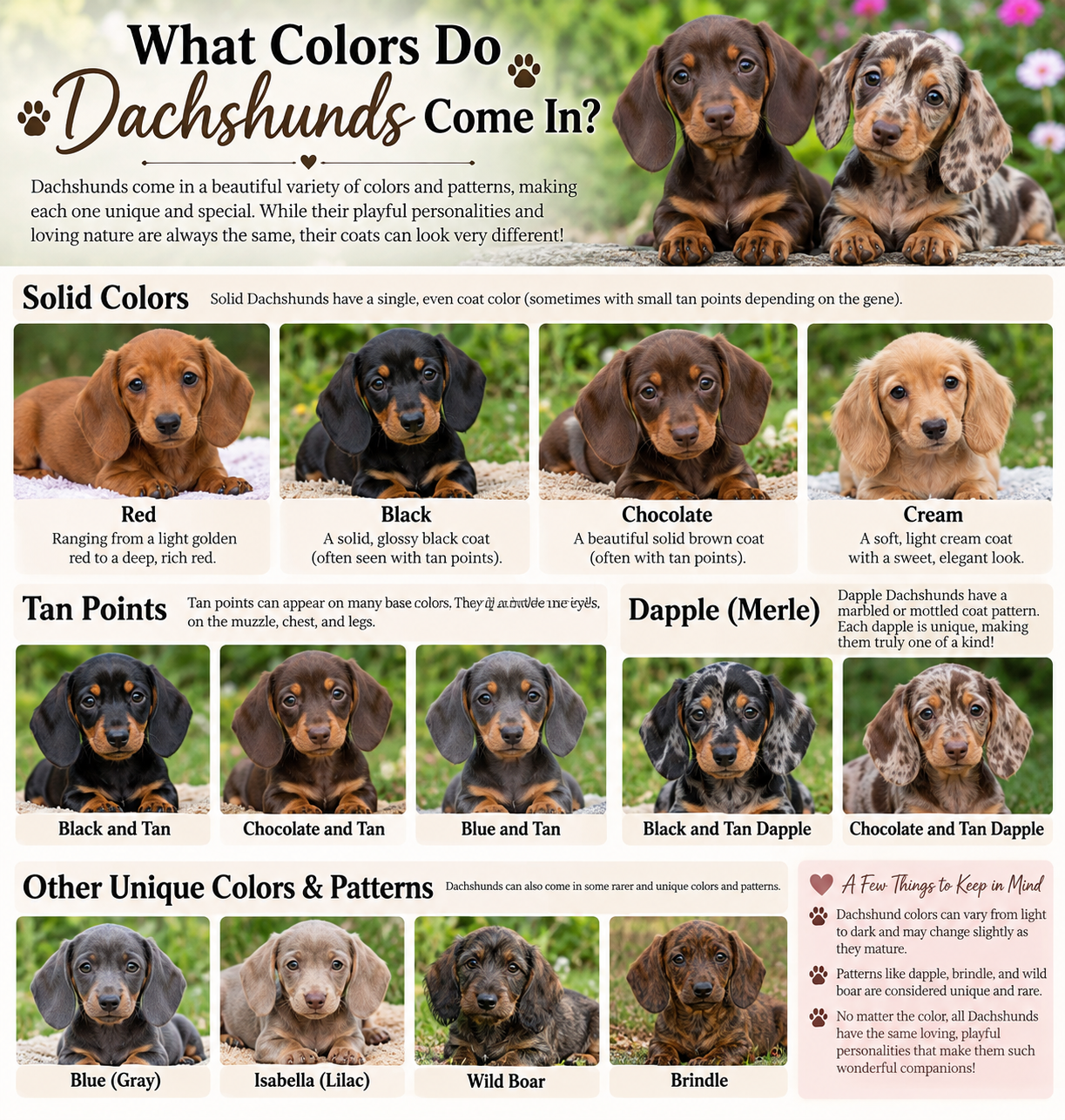
Dachshunds are famous for their long bodies, short legs, playful personalities, and adorable faces. But did you know these little dogs also come in a wonderful variety of coat colors and patterns?
From classic red and black-and-tan Dachshunds to beautiful chocolate, cream, dapple, and brindle varieties, there is a wide range of appearances to admire. Understanding these colors can help you learn more about the breed and decide which look you love most.
At Pittsford Puppies, we know that every puppy has its own special charm. Let’s explore the beautiful colors and patterns Dachshunds can have!
1. Red Dachshund
Red is one of the best-known Dachshund colors. These dogs can range from a light golden-red to a deep, rich reddish-brown. Some have a uniform red coat, while others have darker hairs mixed throughout their coats.
What to look for: A warm red or coppery coat that may become lighter or darker as the puppy matures.
2. Black-and-Tan Dachshund
The black-and-tan Dachshund is a classic favorite. Its coat features a predominantly black body with tan markings above the eyes, on the muzzle, chest, legs, and underneath the tail.
What to look for: A striking contrast between a dark black coat and warm tan markings.
3. Chocolate Dachshund
Chocolate Dachshunds have beautiful brown coats that can range from milk chocolate to a deeper, richer brown. Some are predominantly brown, while others have tan or cream markings.
What to look for: A brown nose and brown coat rather than the black coloring seen in black Dachshunds.
4. Chocolate-and-Tan Dachshund
Chocolate-and-tan Dachshunds combine a chocolate-brown body with lighter tan markings in the familiar pattern seen on black-and-tan dogs.
What to look for: A rich brown body with lighter markings around the eyebrows, muzzle, chest, and legs.
5. Cream Dachshund
Cream Dachshunds have pale coats that range from ivory to a soft golden cream. Their elegant, light-colored coats are especially eye-catching in longhaired Dachshunds.
What to look for: A light cream or blonde appearance rather than a distinctly reddish coat.
6. Black-and-Cream Dachshund
Black-and-cream Dachshunds have a black base coat with pale cream markings instead of the warmer tan markings found on black-and-tan dogs.
What to look for: Dark black coloring paired with lighter markings around the face, chest, and legs.
7. Blue-and-Tan Dachshund
Blue-and-tan Dachshunds have a diluted black coat that appears slate gray or bluish-gray, combined with tan markings.
What to look for: A smoky gray body with lighter tan points.
Important health note: Blue is a dilute coat color, so responsible breeding and appropriate health screening are important when considering dogs with this coloring.
8. Isabella (Fawn)-and-Tan Dachshund
Isabella Dachshunds have a diluted chocolate coloring that creates a soft taupe, grayish-brown, or lilac-brown appearance. When paired with tan points, the contrast can be subtle and beautiful.
What to look for: A pale brown or muted gray-brown coat, often with lighter tan markings.
9. Dapple Dachshund
Dapple, also called merle, describes a coat pattern rather than a separate base color. It creates irregular lighter patches throughout a darker coat. Dapple Dachshunds can have striking combinations, including black-and-tan dapple and chocolate-and-tan dapple.
What to look for: A marbled or mottled coat with contrasting light and dark patches.
Important health note: Breeding two dapple Dachshunds together can produce double-dapple puppies, which have a substantially increased risk of hearing and vision problems. Responsible breeders should understand the genetics involved and avoid this pairing.
10. Brindle Dachshund
Brindle Dachshunds have darker stripes running through a lighter base coat, creating a tiger-striped appearance. The stripes may be subtle or quite noticeable.
What to look for: Dark streaks or stripes across the body rather than the irregular patches of a dapple coat.
11. Piebald Dachshund
Piebald Dachshunds have clearly defined white patches mixed with another coat color. They may be red-and-white, black-and-tan-and-white, or chocolate-and-white, among other combinations. Piebald is a recognized Dachshund pattern, but it is different genetically and visually from dapple.
What to look for: Distinct areas of white rather than the mottled pattern of a dapple.
12. Wild Boar Dachshund
Wild boar is a distinctive coloring most often associated with wirehaired Dachshunds, although it can occur in other coat varieties. Individual hairs contain bands of different colors, giving the dog a grizzled mixture of black, brown, and reddish tones.
What to look for: A textured, multicolored appearance rather than one solid shade.
13. Sable Dachshund
Sable Dachshunds have a lighter base coat with darker-tipped hairs, creating a shaded or overlaid appearance. This is especially noticeable on red or cream-colored coats.
What to look for: Darker hairs concentrated over a lighter underlying color, often giving the coat a shaded effect.
14. Wheaten Dachshund
Wheaten is a pale golden or straw-colored coat most commonly associated with wirehaired Dachshunds. The shade can resemble wheat or a soft golden beige.
What to look for: A light, warm, wheat-colored coat, often paired with the characteristic wiry coat texture.
Dachshund Colors at a Glance
Dachshunds can have many combinations of colors and patterns. Some of the best-known include:
| Group | Examples |
|---|---|
| Solid or predominantly single colors | Red and cream. |
| Two-color combinations | Black-and-tan, chocolate-and-tan, black-and-cream, and chocolate-and-cream. |
| Dilute colors | Blue and Isabella. |
| Distinctive patterns | Dapple, brindle, piebald, and sable. |
| Special coat appearances | Wild boar and wheaten. |
The American Kennel Club lists recognized Dachshund colors and markings, although not every advertised color combination is accepted in the breed standard. You can consult the official AKC Dachshund breed information and the Dachshund Club of America breed standard for more details.
Do Dachshund Puppies Change Color as They Grow?
Yes! Some Dachshund puppies experience noticeable coat changes as they mature. A puppy’s coat may lighten, darken, or develop more visible shading as its adult coat comes in. The amount of change depends on the puppy’s genetics and coat type.
This is one reason it can be helpful to look at a puppy’s parents and family history when learning about its likely adult appearance.
Does Dachshund Color Affect Personality?
A Dachshund’s coat color does not determine whether it will be friendly, playful, energetic, or affectionate. Temperament is influenced by genetics, early experiences, socialization, and training—not simply coat color.
Dachshunds are generally known for their lively, curious, and courageous personalities. Whether you fall in love with a red smooth-coated Dachshund or a chocolate dapple longhair, each individual dog has its own personality.
How to Choose the Right Dachshund Puppy
When choosing a Dachshund puppy, it is natural to have a favorite color. However, color should be just one part of your decision.
Consider:
- Temperament, health, and the puppy’s parents
- Coat type, expected adult size, and lifelong care needs
- How the puppies are raised, and what health screening the breeder can discuss
- For unusual or dilute colors, the relevant genetic considerations
Most importantly, choose a puppy whose needs and personality are a good match for your home.
Find Your Perfect Puppy at Pittsford Puppies
At Pittsford Puppies, we believe every puppy deserves a loving home and every family deserves the opportunity to find a companion that fits its lifestyle.
Dachshunds come in an amazing variety of colors and patterns, but their loyalty, charm, and big personalities are what make them so special.
Whether you love classic red, chocolate-and-tan, cream, dapple, or another beautiful coat, learning about Dachshund colors is a wonderful first step toward finding your favorite.
Visit Pittsford Puppies to learn more about our puppies, or explore our Dachshund puppies to find your new family companion.